


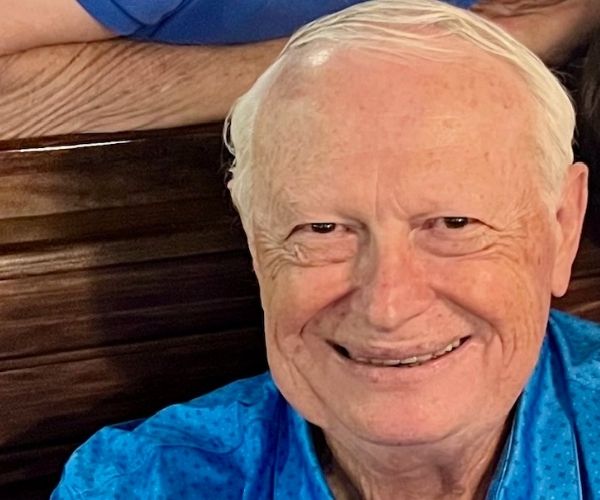
A case of severe blurry vision led 79-year-old Martin Calloway to the eye doctor. Thanks to his long-term, forward-thinking ophthalmologist, Dr. J. Michael Roach of Eye Consultants of Atlanta, an exam helped uncover the heart of the matter: a cardiac issue that could’ve taken the patient’s life.
“Dr. Roach is a true example of making every effort to care for a patient,” Calloway says. “And without him, I may not be here.”
The problem itself originally came into view on the golf course. After bending down to mark his ball in the midst of a game, Calloway experienced a sudden, total loss of vision. He says it felt as if a “big gob of Vaseline” was covering his eyes. After about 30 minutes, the issue went away.
However, the symptom proved troubling enough that Calloway promptly reached out to Dr. Roach, who quickly put his patient on the schedule.
After performing a thorough examination, Dr. Roach saw no glaring ocular issues. However, when a senior experiences sudden blurry vision, he says, ophthalmologists should immediately rule out the more serious conditions. Among them is poor perfusion, an issue of limited blood flow to the eyes.
“The eyes need a good, steady flow of oxygen,” Dr. Roach explains. “If they don’t have an adequate supply, generally the patient is very symptomatic immediately.”
This led Dr. Roach to check Calloway’s pulse, and the physician noticed an irregularity. “I felt his radial artery at his wrist,” says Dr. Roach. “That’s the artery that kind of goes toward the thumb. I sensed an arrhythmia and told Mr. Calloway something was off. I asked him to see his cardiologist on the double.”
Dr. Roach suspected the root cause of the problem was in fact inadequate blood flow to the ophthalmic artery with a heart malfunction as the culprit. His hunch proved correct.
Calloway soon found himself at Piedmont Heart Institute where testing revealed multiple dangerous threats to his heart health. He was experiencing aortic stenosis, also known as the narrowing of his aortic valve, due to calcified leaflets in his aortic valve.
“At that point, every drop of blood in the heart had to fight and pump through a narrow opening,” says Dr. Mark Richard Helmers of Piedmont Heart Cardiothoracic Surgery Atlanta. “It’s kind of
equivalent to taking your thumb and putting it on the end of a garden hose and blocking that opening.”
Additionally, Calloway had coronary artery disease, resulting in a 90% blockage of his lower anterior descending (LAD) artery, commonly known as the “widowmaker.” He also had a 70% occlusion in a third artery. Calloway’s heart was working overtime to bypass the narrow valve while simultaneously being starved of the oxygenated blood it needed to do the job. Calloway was referred to Dr. Helmers, who performed open-heart surgery, including an aortic valve replacement and a double bypass, at Piedmont Atlanta Hospital. The procedure proved successful, and Calloway now finds himself on the other side of a harrowing medical challenge thanks to a proactive ophthalmologist and a skilled team of heart experts.
From the perspective of a cardiac surgeon, Dr. Helmers credits Dr. Roach for choosing a comprehensive medical approach, instead of simply relying on ophthalmology. Although Calloway’s eyes looked fine, Dr. Roach chose to check the patient’s pulse, resulting in diagnostic intuition.
“I think it’s a sign of high-quality comprehensive care,” Dr. Helmers explains. “It’s very important that we as physicians take our patients’ problems seriously and really think of broad differential diagnoses for things that can cause problems. It’s clear that Dr. Roach is really practicing medicine and not solely focused on just one organ system.”
Calloway’s case serves as a reminder that the body is an integrated system where heart problems can manifest in other organs, including the eyes. In fact, the eye is the only organ in the body where providers can non-invasively see vascular health in real time. Thanks to early detection, intervention, and a multidisciplinary team, a possibly fatal situation became a treatable condition.
“Don’t forget the eyes,” Dr. Roach says. “With a really thorough exam, we can find things like brain tumors, strokes, and in Mr. Calloway’s case, cardiac issues. The eyes tell us a lot.”
Today, Calloway says he will always remain “beyond grateful” for Dr. Roach’s attention to detail. He says he believes the ophthalmologist’s approach saved his life.
“Not everybody would have been as lucky as me to have their eye doctor rule out a vision problem, suspect a cardiac problem, and set them on the right path,” Calloway says. “Thank goodness for his deep medical knowledge.”